


Facelift Techniques Explained: Mini, Mid, Full and Neck Lift
If you’ve been researching facelift surgery, you’ve probably already noticed that the term “facelift” covers quite a range of procedures. A mini facelift and a full face and neck lift are very different operations – different in technique, recovery, incisions and cost.
Understanding the options before your consultation means you’ll be able to have a productive conversation with your doctor and arrive with realistic expectations of what each technique can achieve for you.
Here’s a guide to the main facelift techniques available at MINKST, what each one addresses, and what to expect in terms of scarring and recovery.
Facelift Techniques Available at MINKST
At MINKST, your doctor will work with you to determine the right combination of techniques based on your anatomy, the areas you want to address, and the degree of change you’re looking for. Some of our options include:
Mini facelift
Treats early signs of ageing around the lower cheeks and jawline. Ideal for mild skin laxity and subtle, natural-looking rejuvenation.
Mid facelift
Lifts the cheeks and restores volume to the middle of the face. Softens deep smile lines while leaving the neck largely unchanged.
Full facelift (SMAS)
Repositions deeper facial tissue and removes excess skin, addressing moderate to significant signs of ageing for long-lasting results.
Neck lift
Improves loose skin, excess fat and muscle banding beneath the chin and along the neck for a more defined jawline.
Other Face Procedures
There are a range of different face procedures you can combine with a facelift or have standalone. Some of these include:
- Blepharoplasty Eyelid Lift (upper and lower)
- Brow Lift & Temporal Lift
- Chin implant
- Fat transfer to under eye area
- Subnasal lip lift (aka a bull horn lip lift)
Facelift Scar Diagram
Below is a scar diagram for each facelift procedure. Please note your doctor may have a slightly different technique and individual scar lines will vary.
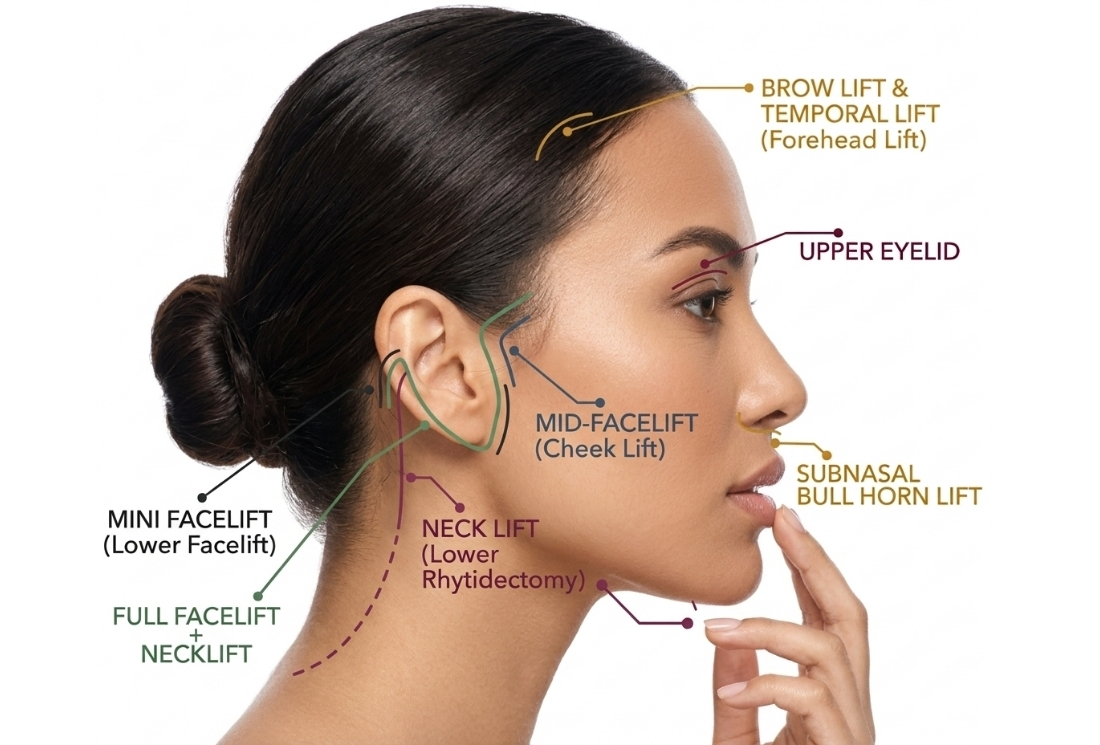
Quick Comparison
| Procedure | Best For | Typical Scar Location | Average Recovery |
|---|---|---|---|
| Mini Facelift | Early jowls and mild skin laxity | Around the front of the ear and temple hairline | 7-14 days |
| Mid Facelift | Sagging cheeks and deep smile lines | Temple hairline or inside the lower eyelid | 2-3 weeks |
| Full Facelift | Moderate to advanced facial ageing | Around the ear and into the hairline | 2-4 weeks |
| Neck Lift | Loose neck skin and muscle bands | Behind the ears and sometimes beneath the chin | 10-14 days |
Note: Recovery times are averages only. Individual healing varies, and many patients choose to take around 2-3 weeks away from work and social events following facial rejuvenation surgery to allow bruising and swelling to subside.
Ready to explore your options?
At MINKST we have doctors located round Australia that specialise in facial rejuvenation procedures. At your consultation, your doctor will assess your anatomy, discuss your goals, and develop a personalised surgical plan – including which technique or combination of techniques is most likely to give you the result you’re after.
Take a look at our facelift before and after results, achieved by MINKST doctors. And when you’re ready, book your refundable surgery consultation – if you decide not to proceed, your consultation fee is fully refundable.
Frequently Asked Questions
A mini facelift targets early-to-moderate sagging in the lower face and jowls, using shorter incisions and a less extensive procedure than a full facelift. A full face and neck lift addresses the entire face and neck, including the forehead, cheeks, jawline and neck, and is better suited to patients with more significant or widespread signs of ageing. A mini facelift typically involves a faster recovery and lower cost, while a full facelift provides more comprehensive and longer-lasting results.
Facelift incisions are deliberately placed in areas that minimise visibility - along the hairline and in the natural crease around the ear, where they are largely concealed by hair and facial contour. Like all surgical scars, facelift scars go through a healing process over 6 to 12 months, progressively becoming paler, flatter and less noticeable. Your surgeon will guide you on scar management to support the best possible healing.
Most patients feel comfortable returning to work and light activities within 10 to 14 days. Strenuous exercise and activities that significantly raise the heart rate are typically avoided for around four weeks. Swelling and bruising continue to resolve over weeks to months, and the final result - including fully settled scars - is generally visible at six to twelve months.
Facelift results typically last seven to ten years, depending on factors such as your skin quality, genetics, lifestyle, and how well you protect your skin from sun exposure. A facelift addresses the visible signs of ageing present at the time of surgery but does not stop the ageing process - some patients choose to have a secondary or touch-up procedure after a number of years.
Yes - and it is common to do so. A facelift is frequently combined with a neck lift, eyelid surgery (blepharoplasty), brow lift, or fat transfer for a more comprehensive result. Your MINKST surgeon will discuss whether any additional procedures would complement your facelift and help you achieve your goals.
Facelifts are most commonly performed on patients in their 40s to 60s, but there is no strict age rule. The right time for a facelift depends on the degree of visible ageing, your skin quality, and your personal goals - not your age. Your surgeon will assess your individual anatomy and advise whether surgery is appropriate for you.